1. INTRODUCTION
The Problem with Conventional Internal Combustion Engines:
The internal combustion engine is fundamentally constrained by a critical design flaw: all three essential thermodynamic stages—compression, combustion, and expansion—occur simultaneously within a single chamber. This creates severe interdependencies and design compromises that prevent optimization.
These compromises are:
- The compression system must be designed around the combustion chamber's thermal and pressure limits
- The combustion process is constrained by the expansion chamber's mechanical requirements
- The expansion system is limited by the pressure requirements needed for the next compression stroke
- Each subsystem fights for priority, and no single component can be optimized without degrading the others
The Jet Engine Paradigm:
In sharp contrast, jet engines and gas turbines demonstrate a superior architectural approach. They elegantly separate the three thermodynamic stages into distinct modules:
- Compression Stage: Dedicated compressor optimized for efficient air compression
- Combustion Stage: Specialized combustor optimized for continuous, efficient burning
- Expansion Stage: Turbine optimized for extracting maximum energy from hot, pressurized gases
This modular separation allows each stage to operate at its optimal conditions, with specialized materials, geometry, and control strategies tailored to its specific function. The result is an engine capable of extreme RPM, excellent power-to-weight ratios, and continuous optimization improvements in each stage.
The Proposed Solution: Applying Jet Engine Principles to Reciprocating Systems:
This document proposes a revolutionary approach: apply the compartmentalized philosophy of jet engines to a reciprocating system by replacing each jet engine stage with its mechanical reciprocating equivalent. This creates a modular rotary turbine engine where:
Compression Stage:
- Jet Engine: Aerodynamic compressor
- Proposed Engine: Mechanical positive displacement compressor (e.g., rotary vane compressor, screw compressor)
Combustion Chamber:
- Jet Engine: Fuel injection and continuous flame holder
- Proposed Engine: Continuous pressurized burner, specialized to any fuel type (e.g., coal burner, heavy tar burner, jet fuel burner, gaseous fuel burner)
Expansion System:
- Jet Engine: Multi-stage turbine
- Proposed Engine: Rotary positive displacement expander (e.g., vane engine—common in pneumatic power tools, scroll expander, gerotor)
By adopting this modular, jet-engine-inspired architecture and coupling all three stages to a single drive shaft, we create an engine that overcomes the fundamental limitations of conventional internal combustion engines while offering unprecedented versatility, efficiency, and scalability.
Addressing Common Criticisms:
Criticism: "This is just a jet engine."
This is fundamentally incorrect. This design is an internal combustion engine, not a jet engine. Key distinctions:
- Operating Cycle: This engine does NOT operate on the Brayton cycle. It operates on a continuous combustion cycle with a positive displacement expander, producing high torque at low RPM.
- Expansion Method: Jet engines use reaction turbines that require optimum RPM to operate efficiently. This design uses a positive displacement expander (vane engine, scroll, gerotor) that produces maximum torque at startup and low speeds, eliminating the need for transmissions.
- Efficiency at Low Speed: Traditional turbines are extremely inefficient at low RPM. This positive displacement design maintains excellent efficiency from startup through high-speed operation.
- Fuel Type: This engine is designed for fuel flexibility (gasoline, diesel, coal, biomass, heavy tar) and continuous combustion. Jet engines are optimized specifically for jet fuel and use continuous combustion in a different context.
- Application: Jet engines power aircraft at cruise altitude with specific thrust requirements. This engine is designed for variable-load applications (vehicles, marine, industrial, power generation) where torque at low speed is critical.
- Architecture: While both use modular separation of compression/combustion/expansion, this engine couples all three modules to a single drive shaft producing mechanical output directly. Jet engines produce thrust via exhaust velocity.
Criticism: "This is just a power plant design, not an engine for vehicles."
This is a misunderstanding of the design's scope and versatility. This IS an engine—fundamentally similar to a jet engine in its modular architecture and scalability, but optimized for diverse applications:
- Engine, Not Power Plant: A jet engine produces mechanical rotational power on a shaft. This design does the same. Both can drive a load directly or via coupling to other systems.
- Scalability: Jet engines range from small turboshaft engines in helicopters (producing hundreds of kW) to massive turbofan engines in commercial aircraft (producing tens of megawatts). This design is similarly scalable across the kW range.
- Direct Vehicle Application: Just as helicopter turboshaft engines directly power rotors, this design can directly power vehicle propellers, wheels, or water jets without modification to the core engine principle.
- Proven Precedent: Turboshaft and turboprop engines demonstrate that gas turbine principles scale to portable, vehicle-mounted applications. This design applies the same principles with additional optimization for variable-load applications.
- Power Density: High-RPM rotary engines enable extreme power density. Jet engines prove this principle; scaling the concept to lower RPM with high torque maintains this advantage while improving usability in variable-load scenarios.
Criticism: "This design would have extreme weight and poor power-to-weight ratio."
This criticism contradicts the fundamental physics demonstrated by jet engines, upon which this design is modeled:
- Proven Power-to-Weight Advantage: Jet engines achieve exceptional power-to-weight ratios precisely because of rotary, non-reciprocating design. A modern jet engine produces 30+ kW per kilogram. Reciprocating engines achieve only 0.5-1 kW per kilogram. This 30-60x advantage is directly attributable to rotary principles.
- Inertia Characteristics: Rotary designs eliminate reciprocating inertia and vibration. This allows:
- Much higher RPM operation (jet engines routinely reach 40,000+ RPM)
- Lighter structural requirements (no massive crankshaft, connecting rods, or reinforced blocks)
- Smaller overall displacement for equivalent power
- Direct correlation: higher RPM × lower mass = higher power-to-weight ratio
- Component Reduction: Compared to reciprocating engines, this design eliminates:
- Crankshaft and connecting rods
- Piston rings and complex valve trains
- Heavy cylinder blocks and heads
- Transmission system (high-torque-at-low-RPM design eliminates gearboxes in many applications)
- Result: Substantially lighter overall package
- Burden of Proof: The claim that this design would have "extreme weight" is purely speculative and contradicts established physics. Jet engines demonstrably achieve superior power-to-weight ratios using the same modular, rotary principles. A practical working prototype would definitively prove or disprove this claim, but theory strongly supports the weight-efficiency advantage.
2. ABSTRACT
This document describes a modular rotary turbine engine design that separates the thermodynamic processes of compression, combustion, and expansion into independent, specialized modules. Unlike conventional internal combustion engines where all three processes occur in a single chamber with complex interdependencies, this design allows each module to be optimized for its specific function, eliminating feedback loops and unlocking revolutionary improvements in efficiency, cost, and reliability.
Key Definition: Positive Displacement Systems
Definition:
A positive displacement device is a machine where a fixed volume of fluid or gas is mechanically trapped and forced to move from inlet to outlet with each stroke or rotation. Unlike reaction turbines that rely on fluid dynamics and velocity-dependent forces, positive displacement devices deliver consistent power output regardless of RPM, with maximum torque available at startup (zero RPM).
Common Examples of Positive Displacement Systems:- Gear Pumps & Motors: Two meshing gears trap fluid between rotor teeth and casing, delivering fixed volume per rotation with high torque at low speeds
- Vane Pumps & Motors: Sliding vanes in a rotor create expanding/contracting chambers, common in pneumatic tools, demonstrating reliable low-RPM high-torque operation
- Scroll Expanders: Interleaving spiral profiles trap gas and expand it through controlled geometry, exemplified by U.S. Patent 7,958,862
- Gerotor (Orbiting Gear) Motors: Inner and outer gears with different tooth counts create expanding cavities, producing smooth power delivery
- Screw Pumps & Compressors: Interlocking screws trap and move fluid/gas along axis with minimal slip
- Maximum Torque at Zero RPM (Startup): Unlike reaction turbines that produce near-zero torque at startup, rotary positive displacement systems deliver full rated torque from rest, ideal for load acceleration without transmission gearboxes
- Constant Force Generation: Mechanical trapping of gas/fluid creates predictable, continuous force throughout rotation, independent of RPM
- No Transmission Required: Pneumatic vane tools exemplify this principle—they operate efficiently from zero to full RPM without speed conversion, directly delivering usable torque to the load
- Mathematically Controlled Displacement: Output volume determined solely by rotor geometry and rotation, allowing precise engineering of expansion ratios and pressure drops
- High Power-to-Weight Ratios: Vane motors used in pneumatic tools demonstrate exceptional power density without the weight penalty of reciprocating systems, achieving 2-5 kW/kg in many applications
- Efficiency Independent of RPM: Maintains reasonable efficiency across wide operating speed range, unlike reaction turbines optimized for single design point
- Smooth Power Delivery: Continuous mechanical force without reciprocating acceleration/deceleration cycles, enabling lighter bearing and structural requirements
- Proven Reliability: Vane motors in pneumatic tools run for years in industrial applications, demonstrating durability and low maintenance requirements
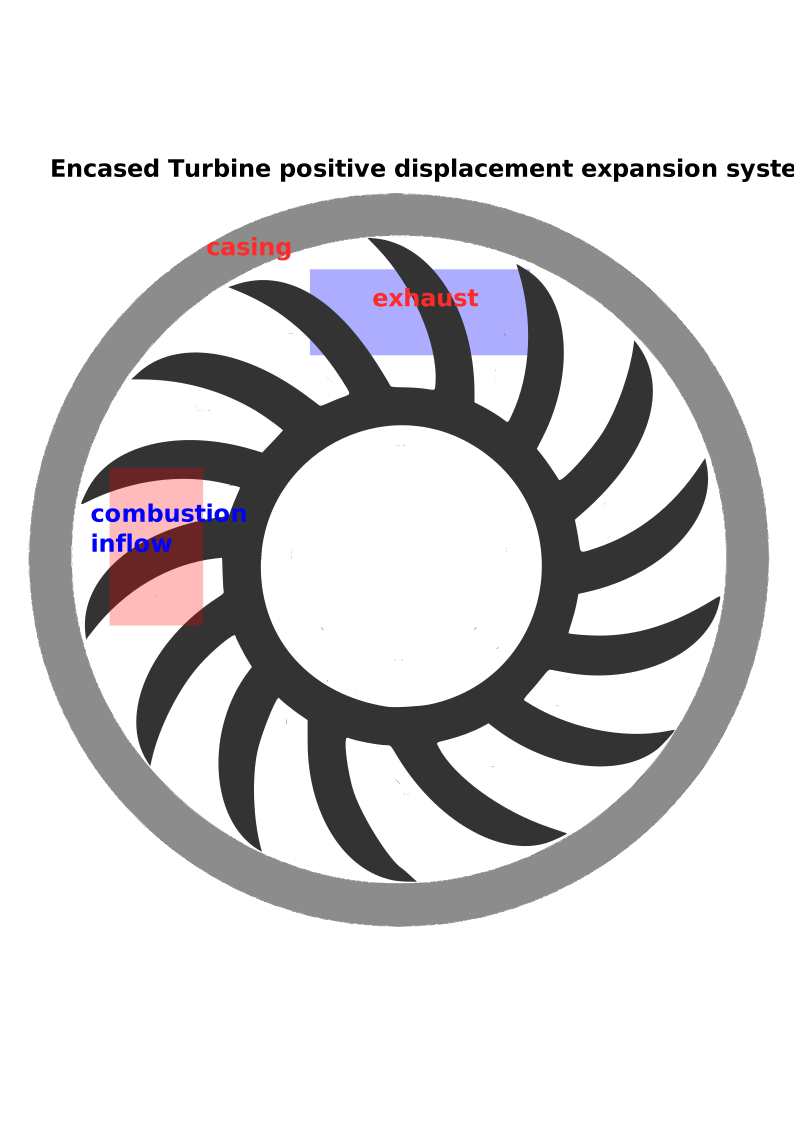
This is what i believe to be the simplest conversion of a turbine into a positive displacement rotary engine. Simply encase the rotor to enforce the behavior. This is an expansion system. Air enters from the high pressure combustion chamber. The initial part of expansion happens here. As the rotor turns, the expanding gas is trapped in the cavity between the rotor and the casing. As the rotor continues to turn, the volume of the combustion chamber continually increases, not the cavity, as air is constantly leaving the combustion chamber into cavities in a step wise manner as the rotor spins. This generates a constant force on the rotor, producing torque throughout the rotation via positive displacement. Finally, the expanded gas is released through an exhaust port as the rotor completes its cycle. This design allows for efficient energy extraction from high-pressure gases at low RPM, making it ideal for applications requiring high torque and smooth operation. Some key features: high pressure air enters from the side wall of the encasement for the turbine and exits at lower pressure through the exhaust port on the opposite side wall. This is most similar to how an actual turbine functions This would have to be a series of turbines to control the expansion. All the turbines in series would be mounted on a single drive shaft and expansion could be controlled via careful calibration of the size of each turbine stage to match the desired expansion ratio. The first turbine is packaging a discrete quantity of air at a given pressure and sending it into the turbine system. The subsequent turbines then expand that air down to atmospheric pressure in a series of stages. Each stage is optimized for a specific pressure ratio and expansion volume. This allows for high efficiency expansion at low RPM with high torque output. Expansion occurs in the combustion/expansion chamber as the air is fed piecemeal into the turbine. While traveling along the circuference of the encasement, no expansion occurs until the air reaches the exhaust port. This allows for a controlled expansion process that maximizes energy extraction from the high pressure air. If the air was compressed 25:1 then expanded down to atmospheric pressure, the theoretical efficiency would be very high, similar to that of a gas turbine operating on the Brayton cycle. The key innovation here is the use of positive displacement expansion in a rotary format, allowing for efficient low RPM operation with high torque output. This design could be used in conjunction with a rotary compressor and a stationary combustion chamber to create a complete modular rotary turbine engine system. This design is fundamentally a turbine intended to trap air and expand it in a precise and controlled positive displacement manner.
This engine is fundamentally a jet engine with a positive displacement expansion system replacing the reaction turbine. Even then, it is very similar to a reaction turbine, save that it traps air in the cavity between the rotor and the encasement, turning the reaction turbine into a positive displacement system with many advantages over a reaction turbine system. Where a reaction turbine relies on fluid dynamics and blade velocity triangles to extract energy, this positive displacement approach mechanically traps the expanding gas and forces it to do work on the rotor. This distinction eliminates the RPM dependency of reaction turbines and enables mathematical control of the expansion process through pure geometric design.
3. BACKGROUND AND PROBLEM STATEMENT
Conventional Internal Combustion Engine Limitations:
- All processes (compression, combustion, expansion) occur in the same chamber
- Interdependencies create complicated feedback loops between functions
- Compression ratio is constrained by pre-ignition limits
- Combustion conditions are constrained by thermal/mechanical limits of the expansion chamber
- Expansion is constrained by the pressure requirements of the next compression stroke
- Each design parameter represents a compromise between competing requirements
- Material selection must satisfy all three processes simultaneously
- Temperature and pressure profiles cannot be independently optimized
- Separates compression (compressor), combustion (combustor), and expansion (turbine) into distinct modules
- Each module can be independently optimized
- Allows specialization of materials, geometry, and operating conditions
- Enables much higher thermodynamic efficiency
- Demonstrates the superiority of modular, specialized design
- Large-scale turbines dominate power generation and aerospace
- Internal combustion engines still power most vehicles despite limitations
- No modular turbine design optimized for small-scale, portable applications
4. CORE INVENTION: MODULAR ROTARY TURBINE ENGINE
4.1 Fundamental Concept
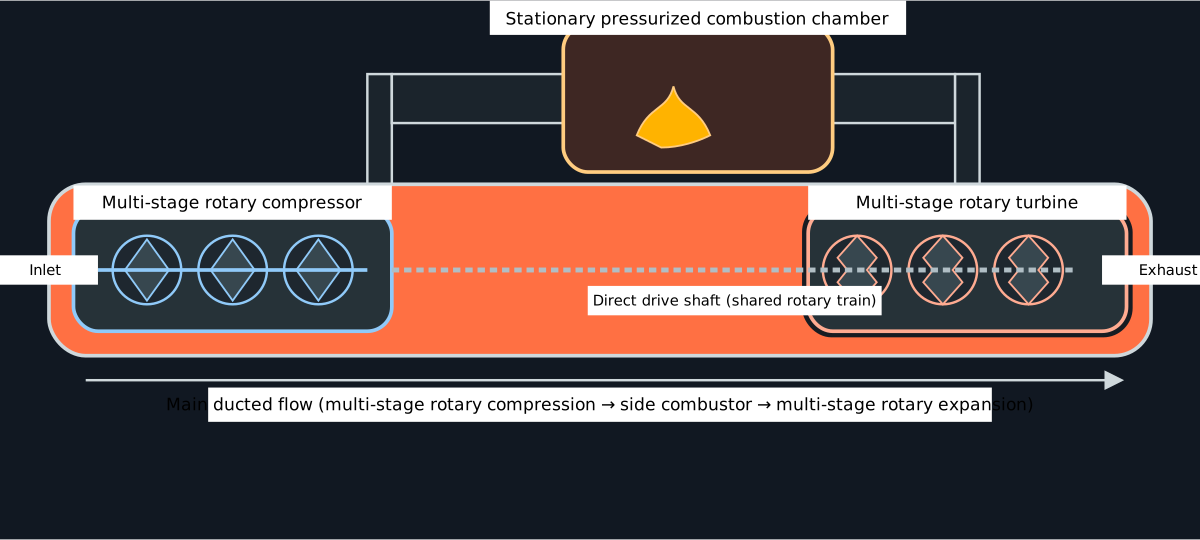
The modular rotary turbine engine separates thermodynamic processes into three independent rotary modules: Module 1 - COMPRESSOR (Rotary Compression)- Independent rotary compressor stage
- Optimized solely for efficient air/fluid compression
- Can achieve high compression ratios without interdependencies
- Material and geometry optimized for pressure cycling only
- Independent, stationary combustion chamber receiving compressed air from compressor
- Continuous burn operation (not pulsed like reciprocating engines)
- Fuel injection optimized for complete, efficient combustion
- Positioned between compressor outlet and expander inlet on drive shaft
- Sustained combustion environment without moving parts
- Provides constant flow of hot, pressurized combustion products to expander
- Chamber geometry optimized for flame propagation and complete mixing
- Material selection optimized for sustained high-temperature combustion
- No reciprocating motion or pulsing - inherently smooth operation
- Independent rotary expander stage on shared drive shaft
- Receives hot, pressurized combustion products from stationary combustor
- Operates on positive displacement principles (NOT traditional reaction turbine)
- Traps pressurized gas and generates constant force/torque as gas expands
- Maintains high pressure differential across expander cavity
- Releases pressurized gas gradually for continuous power delivery
- Optimized for high torque at low RPM operation
- Can be single or multi-stage for pressure ratio optimization
- Material selection optimized for high temperature and pressure expansion
4.2 Mechanical Integration
The three modules are mechanically integrated on a SINGLE DRIVE SHAFT:- Rotary compressor and expander both mounted coaxially on shared shaft
- Compressor is driven by the expander's output power
- Excess expander power drives external load (propulsion, power generation, etc.)
- Single shaft architecture similar to jet engine design for mechanical simplicity
- Combustor is a stationary external chamber (NOT on the shaft) positioned between compressor and expander
- Compressed air flows from rotating compressor to stationary combustor via connecting conduit
- Hot combustion products flow from stationary combustor to rotating expander via connecting conduit
- Enables high power density and direct torque transmission without combustor friction losses
4.3 Key Distinctions from Conventional Engines
Interdependency Elimination:5. OPERATIONAL PRINCIPLES
5.1 Operating Cycle
- Atmospheric air enters the rotary compressor (on intake end of drive shaft)
- Compressor (driven by expander output) pressurizes air to target pressure
- Compressed air flows into stationary combustor chamber
- Fuel is continuously injected and ignited in combustor at optimized conditions
- Hot combustion products at high pressure continuously flow to expander stage
- Expander (on discharge end of drive shaft) traps and expands combustion products
- Expanding gas generates constant force on expander rotor, driving the shaft
- Torque from expander exceeds losses and drives the external load
- Expanded gases exhaust to atmosphere through discharge port
- Single drive shaft simultaneously operates compressor and expander in coordinated fashion
5.2 Steady-State Operation
Unlike reciprocating engines with discrete cycles, this design operates in a continuous, steady-state manner similar to gas turbines:
- No dead volumes from piston movement
- Continuous combustion process
- Smooth rotational output
- Inherently balanced operation
- Reduced vibration compared to reciprocating engines
5.3 Thermodynamic Advantages
Brayton Cycle Efficiency: similar to the Brayton cycle (modern gas turbines)
High Torque at Low RPM: generates constant force throughout rotation
Independent Process Optimization: isentropic efficiency at design speed
6. FUNDAMENTAL LIMITATIONS OF ALTERNATIVE ENGINE DESIGNS
6.1 Reciprocating Internal Combustion Engines
Inherent Design Constraints:
- All three processes (compression, combustion, expansion) occur in same chamber
- Creates inescapable interdependencies between competing requirements
- Each design parameter represents compromise, not optimization
- Limited to 10:1-15:1 compression ratios due to autoignition risk
- Knock/detonation damages engine and limits efficiency gains
- High compression ratios impossible without pre-ignition failure
- Thermal efficiency fundamentally capped by low compression ratios
- Cannot approach theoretical Diesel cycle efficiency
Combustion Process Failures:
- Pulsed, transient combustion instead of stable continuous burn
- Incomplete fuel oxidation leaves unburned hydrocarbons in exhaust
- High emissions of particulates, NOx, and unburned fuel
- Combustion chamber must withstand detonation pressure spikes
- Chamber design compromised by competing requirements
Mechanical Inefficiencies:
- Reciprocating motion creates massive acceleration/deceleration forces each cycle
- Piston inertia limits RPM to 6,000-8,000 typically (15,000 at extreme)
- Energy wasted accelerating/decelerating pistons
- Vibration and stress damage bearings, reduce component life
- Complex valve trains add mass and friction losses
- Power must drive heavy crankshaft, connecting rods, and reciprocating mass
Lubrication Problems:
- Lubricant oil must enter combustion chamber (via piston rings, valve guides)
- Oil vaporization and burning creates emissions and deposits
- Carbon buildup fouls combustor and reduces efficiency
- Oil degradation requires frequent changes (3,000-5,000 miles)
- Oil consumption adds operational cost and environmental impact
Torque Characteristics:
- Low torque at low RPM (near-zero at engine start)
- Requires transmission to convert high-RPM low-torque to usable driving torque
- Transmission adds 10-15% efficiency loss, cost, complexity, weight
- Power losses in fluid coupling and gear mesh friction
- Multiple gears required to cover operating speed range
Part-Load Inefficiency:
- Engines operate at peak efficiency only at narrow RPM band
- Most driving conditions operate at poor efficiency points
- Throttling wastes energy at partial load
- Cannot optimize combustion for varying conditions
Maintenance Burden:
- Complex system with hundreds of moving parts
- Frequent maintenance intervals (oil changes, spark plugs, filters)
- Higher failure rates due to complexity
- Expensive repairs when components fail
- Limited service life compared to simpler designs
6.2 Rotary Wankel Engines
Initial Promise and Fundamental Failure:
- Wankel engines promised smooth rotary operation
- Never achieved commercial success despite decades of development
- Fundamental thermodynamic and mechanical flaws prevent practical use
Seal Failure:
- Apex seals (required to maintain pressure) constantly wear
- High wear rate due to eccentric rotor motion
- Seals cannot maintain pressure differential over engine life
- Compression and expansion volumes leak continuously
- Results in loss of compression and incomplete power stroke
- Engine efficiency degrades rapidly with operating hours
Oil Consumption:
- Seals require continuous lubrication, but leak oil into combustion chamber
- Oil enters combustion chamber through seal gaps
- Excessive oil burning creates blue smoke and emissions
- Violates modern emissions standards
- Oil changes required every 2,000-3,000 miles
- Environmental and cost penalties severe
Poor Combustion:
- Large, elongated combustion chamber creates flame front issues
- Combustion is slow and incomplete
- Unburned fuel emissions far exceed modern standards
- Cannot meet EPA or Euro emissions regulations without extensive aftertreatment
- Energy wasted on inefficient combustion process
Thermal Stress:
- Apex seals experience extreme thermal cycling
- Temperature variations cause seal cracking and failure
- Material science cannot overcome fundamental geometry problem
- Seals have limited service life before replacement needed
Low Power Density Myth:
- While theoretically capable of high RPM, practical power output disappoints
- Combustion inefficiency and seal losses eliminate theoretical advantages
- Real-world power insufficient to justify complexity
- Never competitive with reciprocating engines in practice
Apex Seal Replacement Cost:
- Seal replacement requires engine disassembly
- Labor intensive and expensive procedure
- Frequent replacements over engine lifetime
- Total cost of ownership far exceeds reciprocating engines
- This cost burden killed Wankel development in automotive
Market Failure:
- Despite NSU, Mazda, and other manufacturers attempting commercialization
- Wankel engines never achieved significant market penetration
- All major manufacturers abandoned Wankel development
- Fundamental design flaws proven insurmountable over 70+ years
- Only niche applications survive (military, sport aircraft)
6.3 Electric Motors and Battery Electric Vehicles (BEVs)
Battery Limitations:
- Energy density of lithium batteries ~250 Wh/kg
- Gasoline energy density ~12,000 Wh/kg (48x higher)
- Battery weight for equivalent range prohibitive
- Long-distance travel requires impractical battery masses
- Cost: $100-200/kWh storage vs. $0.50/liter fuel equivalent
Weight Penalty:
- 300-mile range vehicle requires 50-100 kWh battery
- Battery weighs 400-600 kg (880-1320 lbs)
- Additional weight reduces efficiency and range (vicious cycle)
- Vehicles become heavier than traditional cars
- Energy spent accelerating excess weight reduces overall efficiency
Aircraft Propulsion - Fundamental Impossibility:
- Aircraft require specific power (kW per kg) of 1-2 kW/kg minimum
- Battery electric can only achieve 0.1-0.2 kW/kg (10x deficient)
- Example: Small aircraft needing 100 kW power requires:
- Gasoline engine: ~50 kg (500 kW/kg power density)
- Battery system: 1,000-2,000 kg (500x heavier!)
- Weight penalty completely prohibits battery electric aircraft
- Even short-range aircraft impossible with practical battery sizes
- Long-range aircraft would be 90% battery by weight
- Impossible to design aircraft structure to support battery mass
- Electric aircraft limited to very short flights (15-30 minutes)
- Urban air mobility severely constrained by battery weight
- No path to supersonic or long-distance electric flight
- This fundamentally eliminates electric from aviation market
Charging Infrastructure:
- Requires massive infrastructure investment to charge vehicles everywhere
- Public charging stations sparse outside urban areas
- Charging times measured in hours (vs. minutes for fuel)
- Highway travel requires planning around charging stations
- Rural and developing areas impractical for BEVs
Cold Weather Performance:
- Battery efficiency drops 40-50% in freezing temperatures
- Range degradation severe in winter conditions
- Chemical reactions slow at low temperature
- Heating battery consumes significant energy
- Real-world winter range much lower than rated
Grid and Environmental Issues:
- Electricity generation from coal/natural gas not zero-emission
- Well-to-wheel emissions comparable to efficient ICE in many grids
- Requires clean electricity grid (nuclear, renewables) to be truly clean
- Peak demand charging strains electrical grid
- Lithium mining environmentally destructive and energy-intensive
Battery Lifecycle:
- Lithium batteries degrade with cycles (80% capacity after 500-1000 cycles)
- End-of-life recycling complex and energy-intensive
- Battery disposal creates environmental concerns
- Total lifecycle emissions debated (mining, manufacturing, disposal)
- 8-10 year lifespan requires replacement (expensive)
Thermal Management:
- Batteries require precise temperature control
- Cold weather: heating reduces range significantly
- Hot weather: cooling system must work in traffic/extreme conditions
- Thermal management adds complexity and energy consumption
- Arctic/desert conditions problematic
Performance Characteristics:
- Instant torque useful but limited by battery power output
- Maximum power limited by battery current capacity
- Sustained high power impossible (battery overheats)
- Cannot maintain performance over driving cycle
- Repeated acceleration reduces available power (thermal throttling)
Cost:
- Vehicle purchase price includes expensive battery
- $50,000+ for modest-range vehicle
- Battery replacement cost $10,000-20,000 after warranty
- Total cost of ownership high despite low fuel cost
- Subsidies required for market adoption
- Actual range often 20-40% lower than EPA ratings
- Cold weather range degradation severe
- Highway driving at high speeds reduces range significantly
- Charging infrastructure bottleneck preventing long-distance travel
- Consumer acceptance plateauing as real-world limitations emerge
- Mass EV adoption would require doubling electrical generation
- Requires building new power plants and distribution infrastructure
- Timeline for infrastructure buildout measured in decades
- Impractical for global motorization in near-term
- Modular engine uses proven fuel infrastructure
- Refueling takes minutes, comparable to gasoline/diesel
- High energy density fuel enables long range in compact vehicle
- No degradation of performance over vehicle life
- Scalable from portable equipment to industrial applications
- Can be optimized for both efficiency and range
Real-World Limitations Emerging:
Grid Capacity Constraints:
Comparison to Modular Turbine Engine:
6.4 Fundamental Limitations of Jet Engines
Safety: High-Pressure, High-Velocity Exhaust
- Jet engine exhaust velocity typically 300+ m/s (extremely dangerous)
- Exhaust pressure can exceed 5-10 bar in modern turbofans
- High-velocity exhaust creates severe reaction forces and thrust vectors
- Rotor debris in failure scenarios becomes lethal projectiles
- Exhaust blast damages nearby structures, vehicles, and people
- Completely unsuitable for use on domestic streets or populated areas
- Requires expensive heavy shielding and deflector systems
- Environmental hazard: noise levels 100+ decibels at throttle
- Cannot be safely operated near residential areas or city centers
RPM Requirements and Inefficiency at Low Speeds
- Jet turbines operate as reaction turbines dependent on blade velocity triangles
- Efficiency fundamentally tied to operating RPM
- Modern jet engines operate at 30,000-50,000+ RPM
- At startup (0 RPM), reaction turbines produce essentially zero torque
- Torque only increases significantly above 30% of rated speed
- Applications requiring high torque at low speed must use gearboxes
- Gearbox adds 10-20% efficiency loss, significant weight, cost, and mechanical complexity
- Gearboxes reduce reliability and increase maintenance requirements
- Shaft speed matching becomes critical engineering problem
- This creates fundamental incompatibility with low-speed torque applications
Non-Positive Displacement Operation and Uncontrolled Expansion
- Jet engines use reaction turbines—NOT positive displacement devices
- Reaction turbines rely on fluid dynamic forces perpendicular to rotor blades
- Gas expansion process is emergent property of fluid dynamics—NOT mechanically predetermined
- Actual gas flow path cannot be controlled or optimized mathematically
- Secondary flows, shock formations, and vortices create unpredictable losses
- Expansion ratio dependent on blade geometry interpretation of flow
- Flow patterns change with operating conditions and flight envelope
- Off-design operation produces significant losses
- Isentropic efficiency can drop from ~90% at design to ~50% off-design
- Cannot be engineered for specific pressure drop ratios
- Multi-stage turbines attempt to solve this but remain fundamentally fluid-dynamic dependent
Lack of Mathematical Expansion Control
- Jet turbines cannot mathematically control total expansion ratio
- Each turbine stage designed empirically based on CFD and test data
- Expansion characteristics not predetermined by geometry alone
- Cannot optimize each pressure drop stage independently
- Total thermodynamic efficiency constrained by reaction turbine physics
- Cannot achieve theoretical Brayton cycle efficiency due to inherent losses
- Real turbine efficiency typically 85-90%, vs. theoretical 95%+ for positive displacement
- Compression ratio constraints force compromise in system design
- Cannot scale same design across wide RPM range without efficiency penalty
Design Point Optimization vs. Real-World Operation
- Jet engines optimized for single design point (cruise altitude/speed)
- Aircraft spend <1% of flight time at design point
- Takeoff, climb, descent all operate far from design conditions
- Efficiency drops significantly during these off-design operations
- Throttle variations require continuous compression and turbine adjustments
- Variable stator vanes and bleed valves add complexity and losses
- Cannot maintain high efficiency across operating envelope
- This limitation accepted for aircraft due to aerospace requirement for high altitude operation
- Unacceptable for ground-based applications requiring variable-load efficiency
Application Limitations
- Jet engines designed specifically for aircraft and high-speed marine applications
- Optimized for altitude operation where low density and high speed are advantageous
- Poor torque characteristics unsuitable for ground vehicles
- Fuel consumption at low RPM/partial load extremely high
- Cannot operate efficiently in stop-and-go driving patterns
- High noise and vibration unsuitable for civilian transportation
- Complex fuel systems and controls require specialized maintenance
- Limited to military or experimental ground applications historically
6.5 Why This Modular Turbine Design Overcomes These Failures
Advantages Over Reciprocating Engines:
- Modular separation eliminates compression/combustion/expansion interdependencies
- High compression ratios (40:1+) safely achievable without detonation
- Continuous stable combustion enables higher efficiency
- Direct low-RPM high-torque output eliminates transmission losses
- Cleaner combustion due to oil-free combustor chamber
- Simpler design with fewer failure modes
Advantages Over Wankel Engines:
- Single rotating shaft instead of eccentric rotor eliminates seal wear issues
- No complex apex seal geometry prone to failure
- Combustion chamber optimized specifically for combustion (not geometry compromise)
- Oil sealed compressor proven reliable (long service life)
- No oil burning in combustion chamber
- Practical efficiency achievable without seal degradation
Advantages Over Electric Motors:
- Uses existing fuel infrastructure (gasoline, diesel, natural gas)
- Refueling in minutes vs. hours charging
- High energy density fuel enables long range in light vehicle
- No battery weight penalty reducing efficiency
- Performance does not degrade in cold weather
- No degradation over vehicle lifetime (fuel-based, not cycle-limited)
- Far lower cost than battery electric systems
- Scalable to any size from portable to industrial without battery constraint
Synergistic Solution:
- Combines continuous rotation efficiency of Wankel concept
- Eliminates reciprocating engine complexity and compromise
- Operates reliably unlike failed seal-based Wankel designs
- Uses proven infrastructure unlike battery-dependent electric
- Achieves efficiency of gas turbines in portable, scalable package
- No fundamental flaws preventing practical implementation
7. THEORETICAL BENEFITS OF THIS DESIGN
7.1 Single Drive Shaft Architecture - Extreme Simplicity
Mechanical Simplicity:
- Single drive shaft architecture means theoretically only ONE primary moving part (the shaft itself)
- All components (compressor, expander) rotate together as one integrated system
- Eliminates complex gear trains, multiple shafts, and coupling mechanisms
- Vastly simpler design than multi-shaft turbine or reciprocating engine systems
- Fewer bearings, seals, and rotating interfaces required
Maintenance Implications:
- Reduced maintenance intervals due to fewer moving parts
- Simpler bearing and seal systems compared to multi-shaft designs
- Fewer components subject to wear and failure
- Lower operational complexity reduces failure modes
- Easier diagnosis of problems with simplified architecture
- Potential for longer component life through reduced stress concentration
Reliability and Durability:
- Fewer failure points means higher reliability
- Integrated design reduces vibration and stress from misalignment
- Single shaft can be designed for optimal balance and stiffness
- Simplified control systems reduce failure potential
- Lower overall system complexity improves field reliability
Cost and Manufacturing:
- Simpler design reduces manufacturing complexity
- Fewer machining operations and assembly steps
- Reduced parts inventory and supply chain management
- Lower production costs compared to complex multi-shaft systems
- Easier to maintain and repair in field conditions
7.2 Separation of Lubricant from Combustion Chamber
Emission and Efficiency Benefits:
- Combustion chamber contains ONLY fuel and air - no lubricant oils
- Eliminates oil combustion byproducts and emissions
- No hydrocarbon emissions from oil vaporization and combustion
- Cleaner exhaust with reduced particulate matter and unburned hydrocarbons
- Significantly reduces regulated emissions compared to reciprocating engines
Superior Combustion Process:
- Pure fuel/air mixture allows for optimal combustion chemistry
- No oil residues or deposits forming on combustor walls
- Complete fuel oxidation without interference from oil vapors
- Combustor chamber remains clean throughout operation
- Allows for higher flame temperatures and complete burn
Lubrication on Compression Side:
- Lubricant applied only to compression stage bearings and seals
- Lubricant serves dual purpose: reducing friction AND improving sealing
- Lubricant can be optimized for compression environment (not combustion)
- Oil film between compressor rotor and housing improves volumetric efficiency
- Reduces pressure losses and improves compression performance
- Oil-sealed compressors well-established technology with proven reliability
Seal Performance:
- Oil lubrication in compression stage dramatically improves seal effectiveness
- Reduces gas leakage during compression stroke
- Improves compressor efficiency and discharge pressure
- Enables higher compression ratios through better sealing
- Oil naturally wets metal surfaces and provides better dynamic seals
Environmental and Health Benefits:
- Reduced oil consumption compared to reciprocating engines
- No oil burning or vaporization in combustion
- Lower environmental impact and better air quality
- Reduced health impacts from exhaust emissions
- Potential for meeting strict emissions standards easily
7.3 Non-Reciprocating Design - High RPM and Power Density
Mechanical Advantages of Continuous Rotation:
- Eliminates reciprocating motion with its inherent vibration and stress
- Continuous rotation allows much higher RPM operation safely
- No acceleration/deceleration of massive pistons each cycle
- No impact loads from combustion explosions on structures
- Smoother power delivery throughout rotation
High RPM Capability:
- Reciprocating engines limited to 6,000-8,000 RPM due to piston inertia
- Racing engines push to 10,000-15,000 RPM with extreme engineering
- Rotating designs can safely operate at 20,000+ RPM
- Higher RPM enables smaller displacement for equivalent power
- Inherently smoother operation at high speed due to lack of reciprocation
- Enables compact, lightweight designs through high-speed operation
Low RPM Torque and Transmission Elimination:
- CRITICAL ADVANTAGE:
- Positive displacement expander delivers maximum torque at startup and low speeds
- Unlike traditional turbines that require high RPM for efficiency
- Unlike reciprocating engines that produce low torque at low speeds
- This eliminates the need for complex transmission systems in many applications
Elimination of Transmission Systems:
- Traditional engines require transmissions to convert high-RPM low-torque to low-RPM high-torque
- Transmissions are complex, heavy, inefficient, and expensive
- Hydraulic fluid friction and mechanical losses reduce efficiency by 10-15%
- Modular engine produces high torque at low RPM naturally
- Direct coupling to load becomes possible
- Revolutionary for applications traditionally requiring transmissions:
Rail and Train Applications:
- Modern diesel trains use diesel-electric systems for efficiency
- Diesel engine drives electrical generator, electricity drives electric motors
- This conversion exists ONLY because diesel engines can't produce usable torque at low speed
- Diesel-electric conversion suffers ~30-40% efficiency losses in conversion process
- This modular turbine produces high torque directly at low speed
- Direct mechanical coupling to wheels possible without electricity conversion
- Eliminates generator, electrical distribution, and electric motor complexity
- Recovers 30-40% efficiency lost in diesel-electric systems
- Massive fuel savings for rail transport (one of largest diesel fuel consumers)
- Potential to revolutionize rail transport efficiency and economics
Marine Propulsion:
- Ships typically use high-RPM diesel engines with reduction gears
- Reduction gears are massive, heavy, and cause efficiency losses
- Direct low-RPM high-torque output can drive propeller more efficiently
- Smaller, lighter gearboxes or direct coupling possible
- Improved fuel efficiency for maritime transport
Heavy Equipment and Industrial:
- Construction equipment, mining machinery traditionally need torque converters
- Direct drive from modular turbine eliminates converter losses
- Simpler hydraulic systems or mechanical coupling possible
- Lower maintenance and longer equipment life
Electric Generation:
- While not eliminating transmission, low-RPM operation allows direct generator coupling
- Enables compact, efficient power generation systems
- Reduces gearbox losses in power generation applications
Power Density Advantages:
- Power per displacement increases significantly with RPM
- Example: 1-liter engine at 20,000 RPM produces equivalent power to 4-5 liter reciprocating engine at 6,000 RPM
- Result: Much lighter, more compact engines for same power output
- Power-to-weight ratio dramatically superior to reciprocating engines
- Enables weight reduction for vehicles, aircraft, and portable equipment
Speed Range Performance:
- Excellent power delivery across wide RPM range
- Positive displacement expander maintains efficiency from low to high RPM
- No peak efficiency at narrow RPM band like turbines
- Scalable to any desired operating speed
- Inherent balance at high speeds reduces vibration concerns
Weight Reduction:
- Smaller overall displacement needed
- Fewer heavy components (no piston rods, crank shafts, complex valve trains)
- Lighter weight structure due to simpler design
- Direct power delivery without transmission losses
- Vehicles and aircraft can be significantly lighter
- Energy spent accelerating vehicle mass reduced
Application Benefits:
- Aircraft: Lighter engines enable longer range or greater payload
- Automotive: Reduced weight improves fuel efficiency and performance
- Marine: Compact engines reduce space requirements and weight
- Portable equipment: Lightweight generators and power tools possible
- Aerospace: Power-to-weight critical for space/altitude performance
7.4 Specialized Combustion Chamber - Fuel Flexibility and Performance
Continuous Burn Optimization:
- Stationary combustor designed specifically for continuous combustion
- No pulsed pressure waves or transient combustion like reciprocating engines
- Flame front can stabilize and optimize for complete combustion
- Residence time of fuel/air mixture optimized for 100% oxidation
- Temperature profiles controlled and optimized
- Combustor can run at steady-state conditions indefinitely
Superior Combustion Control:
- Fuel injection timing optimized without concern for valve operation
- Injection pressure and pattern tailored for combustion chamber geometry
- Flame front position stable and controllable
- Combustion efficiency approaches theoretical maximum
- Reduced unburned hydrocarbons and particulate emissions
- Complete oxidation of fuel molecules
Alternative Fuel Capability:
- Design allows for solid fuel integration (coal particles, biomass)
- Continuous burn at controlled temperatures burns diverse fuels completely
- Liquid fuels: gasoline, diesel, kerosene, biofuels, synthetic fuels
- Gaseous fuels: natural gas, hydrogen, biogas, syngas
- Fuel switching possible with simple combustor redesign
- Enables utilization of abundant or alternative energy sources
Solid Fuel Application:
- Combustor chamber designed for particle injection and burnout
- Continuous flame supports particle ignition and burning
- Residence time ensures complete particle combustion
- Ash handling systems can remove solids from exhaust
- Enables use of coal, biomass, waste materials as fuel
- Revolutionary potential for coal-based power generation
- Could enable small-scale or distributed solid-fuel power plants
- Historical coal infrastructure could be leveraged
Ultra-High Compression Ratios:
- Compressed air temperature rises with compression ratio
- Stationary combustor with continuous ignition eliminates detonation risk
- Compression ratio NOT limited by autoignition threshold
- Can operate at compression ratios of 40:1, 50:1, or higher safely
- Higher compression ratios = higher thermodynamic efficiency
- Brayton cycle efficiency = 1 - 1/(PR^((gamma-1)/gamma)) where PR = pressure ratio and gamma = heat capacity ratio
- Example: 50:1 compression ratio approaches 75%+ theoretical efficiency
- Reciprocating engines limited to 15:1 due to knocking
Combustion Temperature Control:
- Continuous burn allows precise temperature management
- Temperature sensors provide feedback for fuel adjustment
- Excess air can be supplied to control combustion temperature
- Stoichiometric ratio optimized for complete combustion
- No over-temperature conditions from detonation
- Thermal stress on materials controlled and predictable
7.5 Heat Recovery and Combined Cycle Operation
Modern Power Plant Thermodynamics:
- Conventional gas turbine power plants achieve 35-40% thermal efficiency
- Combined cycle (gas turbine + steam turbine) achieves 55-60% efficiency
- Waste heat from hot exhaust drives steam turbine for additional power
- Two-stage power generation extracts energy at different temperature levels
- This design enables similar combined cycle operation
Waste Heat Recovery:
- Exhaust temperatures from expander naturally high (similar to gas turbines)
- Heat exchanger recovers thermal energy from exhaust stream
- Can heat working fluids for secondary power generation
- Dramatically improves overall system efficiency
- Recovers energy otherwise lost to atmosphere
Combined Cycle Implementation:
- Primary cycle: Compressed air combustion + positive displacement expansion
- Secondary cycle: Steam turbine driven by heat recovery
- Hot exhaust gases heat water to generate steam
- Steam turbine produces additional power on separate shaft
- Combined cycle efficiency approaches 60% or higher
CO2 and Thermal Energy Systems:
- Recovered heat drives CO2 cycles (supercritical CO2 power cycles)
- Alternative working fluids: ammonia, organic Rankine fluids
- Supercritical CO2 cycles more compact than steam cycles
- Better efficiency at lower temperatures than steam
- Modern supercritical CO2 cycles achieve 50%+ efficiency in waste heat recovery
Thermal Energy Utilization:
- Excess heat can provide space heating, hot water, or process heat
- Combined heat and power (CHP) systems
- Industrial applications benefit from waste heat for manufacturing processes
- District heating systems using recovered thermal energy
- Reduces overall fuel consumption through thermal energy reuse
Applications for High Efficiency:
- Marine propulsion: Modern containerships demand efficiency
- Super tankers: Heavy fuel oil burning benefits from waste heat recovery
- Industrial power generation: CHP applications for manufacturing
- Data center power: Utilizing waste heat for facility heating
- Desalination: Waste heat for water purification
- Chemical processing: Industrial heat requirements
Efficiency Comparison:
- Reciprocating engines: 25-35% thermal efficiency (best case diesel)
- Simple gas turbine: 35-40% efficiency
- Reciprocating + recovery: Still limited by ICE fundamentals (40-45%)
- This modular design + waste heat: 55-65% efficiency potential
- Approaches or exceeds modern power plant efficiency standards
- Dramatically reduces fuel consumption per unit of useful work
- Higher efficiency = reduced fuel consumption
- Reduced fuel consumption = fewer emissions per unit of energy
- Lower CO2 emissions for equivalent power output
- Potential to meet strict emissions standards
- Cost savings through reduced fuel requirements
7.6 Combined Benefits - Integrated Advantages
System Integration:
- All benefits work synergistically when combined
- Simplicity + efficiency + flexibility creates unique engine
- Maintenance benefits reduce operational costs
- Efficiency benefits reduce fuel costs
- Fuel flexibility enables cost optimization
- Lightweight design improves performance across applications
Performance/Efficiency Envelope:
- High power-to-weight ratio from non-reciprocating, high-RPM design
- High thermal efficiency from modular separation and heat recovery
- High torque from positive displacement expansion
- Flexibility in operating conditions and fuel types
- Superior to existing solutions across multiple performance metrics
Market Differentiation:
- No other engine type combines all these benefits
- Superior efficiency and emissions vs. reciprocating engines
- Superior torque and scalability vs. traditional turbines
- Fuel flexibility enables new applications
- Maintenance/reliability advantages reduce total cost of ownership
8. ADVANTAGES OVER CONVENTIONAL INTERNAL COMBUSTION ENGINES
Efficiency: without knock/detonation
Power Density:
Modularity and Flexibility: and optimized independently
Material Selection: for pressure/fatigue only
Operational Characteristics: output (no power strokes vs. dead strokes)
9. ADVANTAGES OVER EXISTING TURBINE DESIGNS
High Torque at Low RPM
- Traditional turbines require high speed for efficiency
- Positive displacement expansion generates constant torque
- Can deliver maximum torque from low RPM startup
- Ideal for mobile applications requiring rapid acceleration
- Eliminates need for complex transmission systems in some applications
Efficiency at Variable Speeds
- Traditional designs suffer efficiency loss at off-design RPM
- Positive displacement expander maintains relatively constant efficiency
- Better part-load operation for variable-speed applications
Scalability to Smaller Sizes
- Traditional turbines optimized for large MW-scale systems
- Rotary expanders scale well to smaller applications
- This design applicable to kW range efficiently
Fuel Flexibility
- Can operate with various fuel types
- Combustor can be optimized for specific fuel properties
- Easier fuel switching compared to fixed turbine designs
Cost Efficiency
- Cost-effective for targeted applications
- Modular approach allows incremental development
- Potential for lower production costs at smaller scales
10. MECHANICAL REALIZATION
10.1 Rotary Compressor Module
The compressor section uses rotary principles:
- Centrifugal, axial, or rotary positive displacement designs applicable
- Single or multi-stage configuration possible
- Inlet air receives filtered atmospheric air
- Outlet pressure matched to combustor inlet requirements
Multi-Stage Compressor Configuration
- Three-stage centrifugal design: capable of achieving 15-25:1 compression ratio
- Stage loading: each stage provides ~2.5-3:1 pressure ratio for balanced loading
- Heat recovery potential: interstage compression generates significant heat; opportunity for heat recapture in system thermal management
Alternative Compression Approaches
- Design is not limited to rotary compression systems
- Piston-based compression (reciprocating compressors as used in air conditioning/refrigeration) can be integrated if performance characteristics are superior
- Hybrid compression approaches combining rotary and piston stages viable
- Selection driven by optimization for specific application requirements (efficiency, weight, cost, pressure ratio)
- Key requirement: compression module provides pressurized air to combustor at required conditions
- Modular architecture allows implementation flexibility based on engineering analysis and performance testing
10.2 Combustor Module
The combustion chamber (stationary):
- Positioned between compressor outlet and expander inlet
- Receives pressurized air from compressor at controlled flow rate
- Fuel injection system optimized for mixing and atomization
- Ignition system (spark, glow plug, or continuous combustor)
- Continuous burn operation providing steady flow to expander
- Chamber geometry optimized for flame stabilization and residence time
- Pressure and temperature steady-state rather than pulsed
- Outlet manifold directs hot products to expander inlet port
- Thermally isolated from rotating components
10.3 Expander Module
The expansion/expander section (positive displacement):
- Mounted on discharge end of shared drive shaft
- Receives hot combustion products from stationary combustor at high pressure
- Operates on positive displacement principles (volumetric expansion)
- Traps pressurized gas in sealed cavity/chamber and gradually expands it
- Generates constant expanding force throughout rotation cycle
- Maintains high pressure differential across expander rotor
- Multi-stage configuration possible for different pressure ratios or speeds
- High torque generation even at low RPM operation
- Exhaust back-pressure near atmospheric (discharge port to atmosphere)
- Direct mechanical coupling to compressor via shared shaft
- Possible designs: rotary piston, Wankel-type, vane-type, or other positive displacement expanders
10.4 Auxiliary Components
Control and Integration:
- Fuel metering system matched to compressor output
- Ignition timing/control system
- Bearing and sealing systems for rotary shafts
- Gearbox (if speed matching required between modules)
- Exhaust system with acoustic treatment if needed
11. AUXILIARY COMPONENTS AND INTEGRATION
Modular Design Benefits
- Compressor, combustor, and expander manufactured as independent modules
- Each module optimizable for its function without interdependency constraints
- Modules can be produced by specialized manufacturers or facilities
- Allows for incremental improvements to individual components
- Plug-and-play functionality enables quick replacement and field upgrades
- Problem identification simplified through modular isolation
- Independent teams can optimize their specific module without affecting others
Simplified Component Design
- Stationary combustor eliminates need for rotating combustion chamber seals
- Positive displacement expander uses proven rotary principles scaled appropriately
- Centrifugal compressor stages utilize well-established manufacturing processes
- Shared drive shaft architecture reduces complexity vs. independent turbomachinery
Power-to-Weight Optimization
- Higher RPM operation enables compact, lightweight designs
- Elimination of transmission system (as in vane engines used in pneumatic tools) significantly reduces weight
- Direct low-RPM high-torque output removes need for speed reduction gearing in many applications
- Material quantity reduced through compact high-speed design
- Modular approach allows optimization of weight distribution
Application-Specific Optimization
- Aircraft engines: Can trade efficiency for weight; lightweight engine with high power output acceptable if not maximally efficient; every gram of weight reduction improves range and payload
- Marine propulsion: Container ships and large vessels benefit from heavy, efficiency-optimized engines; fuel cost dominates operational expenses; higher efficiency directly translates to cost savings
- Rail transport: Weight less critical than efficiency; locomotives benefit from maximum fuel economy and reliability; modular design enables long-term optimization
- Portable power: Weight critical for portability; compact, lightweight modules essential
- Single platform can be adapted across applications through module selection and optimization strategy
Scalability for Production
- Design scales across kW range without fundamental redesign
- Modular approach enables incremental ramp-up of production
- Smaller units feasible for early market penetration
- Single platform can address multiple power rating requirements
Cost Efficiency in Manufacturing
- Rotary machinery has mature supply chains and tooling
- Lower precision requirements in some areas compared to traditional turbines
- Modular assembly reduces specialized assembly expertise needed
- Potential for lower per-unit production costs at moderate volumes
- Quick replacement capability reduces warranty and service costs
12. CONTROL AND OPERATING ENVELOPE
Steady-State Control: by fuel flow rate to combustor
Start-Up Sequence: or external means spins compressor initially
Load Following: to load changes
Efficiency Envelope: at design operating point
13. APPLICATIONS
Potential applications for this modular turbine design include: Portable Power Generation: systems
Propulsion Systems: aircraft
Hybrid Systems: of hybrid electric powerplants
Industrial Applications: and power (CHP) systems
14. TECHNICAL SCOPE AND CLAIMS
This design encompasses:
- A modular engine design with compression, combustion, and expansion stages integrated on a SINGLE DRIVE SHAFT
- COMPRESSOR and EXPANDER both mounted coaxially on the shared rotating shaft
- COMBUSTOR as a stationary chamber positioned between compressor outlet and expander inlet, operating via continuous burn
- EXPANDER operating on POSITIVE DISPLACEMENT principles (not reaction turbine) generating constant force through gradual gas expansion
- Coordinated operation where expander power drives compressor and external load simultaneously on single shaft
- Multi-stage compression and/or multi-stage expansion for optimized pressure ratios and efficiency
- High torque generation at low RPM operation through positive displacement expansion mechanics
- Independent optimization of each module for its specific function without interdependency constraints
- Continuous, steady-state operation with stable combustion providing uninterrupted flow to expander
- Integration configurations for various power levels and applications
- Material selection strategies optimized per module rather than compromise selections for single chambers
- Any and all variations, modifications, and extensions of the above concept
15. PRIOR ART CONSIDERATIONS
This design builds upon well-established principles:
- Modern gas turbines and jet engines successfully employ modular separation
- Rotary compressor technology is mature and widely used
- Combustor design for gas turbines is established
- Rotary turbine expansion stages are proven technology
Notable Prior Art: Scroll Expander Technology
An important predecessor to this work is U.S. Patent 7,958,862, which describes a rotary positive displacement expander concept. This patent was acquired by SECCO2, which received DARPA Stage 2 funding for development of rotary positive displacement engines. The inventor's concept of using scroll expanders for efficient energy extraction from pressurized gas represents significant prior art in the field of rotary expansion systems.
The original inventor has since passed away due to cancer, but their foundational work on scroll expander technology remains critically important to the field. The concept of rotary positive displacement expansion—whether through scroll, gerotor, or vane mechanisms—represents a key innovation in thermodynamic energy conversion that this design leverages and extends.
Patent Reference: U.S. Patent 7,958,862 - Rotary Positive Displacement Expander
The novelty of this present work lies in:
- Integration of positive displacement expansion with modular compressor and combustor on single drive shaft
- Systematic optimization approach enabled by complete modular separation
- Multi-stage expansion configuration for controlled pressure ratios
- Mathematical control of expansion process through geometric design
- Scalability to diverse applications from portable to industrial
- Safety-optimized design for domestic and civilian applications
This combination of proven positive displacement expansion technology with dedicated compressor and combustor modules in an optimized integrated arrangement constitutes a significant advancement over existing designs.
16. CONCLUSION
The modular rotary turbine engine represents a fundamental improvement in engine design philosophy by separating interdependent functions into optimized, independent modules. By applying proven gas turbine principles to a scalable, integrated package, this design enables superior efficiency, reliability, and operational characteristics compared to conventional internal combustion engines while providing advantages over existing large-scale turbine designs. This defensive publication establishes the core concept, design principles, and implementation approaches for this innovation, preventing future patenting of substantially similar designs and disclosing the state of the art in modular turbine engine design as of January 17, 2026.